Acoustic Engineering for High-Performance Italian Furniture in Dubai
The specification for high-performance italian furniture Dubai is more than an aesthetic choice; it is an engineering decision that directly impacts asset value through acoustic and vibrational control. While aesthetics are important, the underlying material science and assembly techniques determine the true acoustic performance of a space. A 3dB increase represents a doubling of sound energy, and common fit-outs can introduce numerous flanking paths that may degrade a high-performance wall’s Sound Transmission Class (STC) rating by 10-15dB in real-world conditions. Achieving privacy and cognitive focus depends on a holistic approach to acoustic design that includes the furniture itself.
Deconstructing Acoustic Flanking Paths
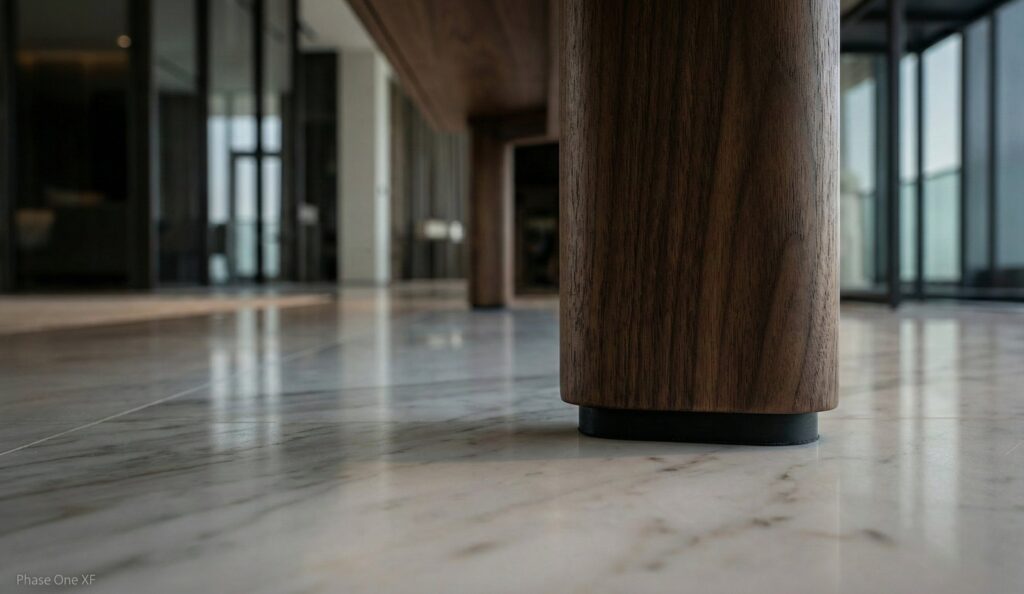
Acoustic flanking is the primary challenge in achieving true sound isolation, particularly within the steel and glass structures common in Dubai. A client may invest in STC-60 rated partitions, a specification that meets Dubai Municipality (DM) standards, only to have the system’s performance compromised by the furniture, fixtures, and equipment (FF&E). Sound energy is both airborne and structure-borne. A rigidly mounted headboard, media unit, or credenza can act as a transmission bridge for sound waves, bypassing insulated and decoupled wall assemblies. Standard furniture is typically designed for appearance and mass, not for acoustic decoupling. Its joinery is rigid, and its contact points with the building structure are not engineered to mitigate sound transmission. An engineered approach models how furniture interacts with building systems, from suspended ceilings to curtain wall mullions, to identify and neutralize noise paths. This involves using integrated constrained layer damping (CLD) within furniture carcasses and specifying non-rigid, polymer-based isolation pads at all contact points to create an impedance mismatch for acoustic energy.
Vibration Isolation: Engineering Beyond the Floor Slab
Low-frequency vibration from building services, structural movement, or impact noise from adjacent units can transmit directly into a living space through furniture. This persistent, low-amplitude structural vibration can degrade cognitive performance and disrupt sleep cycles. Effective vibration isolation requires engineering the furniture to be a dissipative system. This begins with material selection, such as kiln-dried, high-density hardwoods with a moisture content below 8% to ensure dimensional stability in the region’s climate. The core strategy applies mass-spring-damper principles at the component level. For instance, a media console’s internal shelving can be mounted on neoprene bushings, while its main body is decoupled from the floor using dampers calibrated to the building’s typical resonant frequencies. While base-build contracts, such as those guided by FIDIC, define broad vibration criteria, they do not typically extend to FF&E. An engineered approach bridges this gap by treating each piece of furniture as precision equipment designed to isolate the user from the building’s structural noise floor. This manufacturing philosophy prioritizes acoustic performance through specialized joinery and damping materials.

Performance Metrics: A Comparative Analysis
The following table illustrates the difference between a partition’s laboratory rating and its actual field performance when standard versus acoustically engineered furniture is introduced.
| Acoustic Metric | Impact with Standard Furniture | Impact with Engineered Furniture |
|---|---|---|
| Baseline Wall Specification (Lab Rating) | STC 55 | STC 55 |
| Field-Tested Performance (NIC) | NIC 43-47 (Performance loss due to flanking) | NIC 52-54 (Performance preserved) |
| Decibel Attenuation @ 125 Hz | 32 dB | 40 dB (Improved low-frequency isolation) |
| Decibel Attenuation @ 4000 Hz | 61 dB | 65 dB (Enhanced high-frequency clarity) |
Frequently Asked Questions
My architect specified STC-rated walls and acoustic glazing. Is that not sufficient?
While essential, these specifications are only part of the solution. STC is a laboratory rating for a single component in isolation. It does not account for flanking paths—indirect routes for sound. Furniture, cabinetry, and flooring can physically bridge your high-performance walls, creating flanking paths that compromise their effectiveness. Engineered furniture is designed to decouple from the structure, thereby preserving the acoustic integrity of the architectural design.
How does this level of engineering affect asset value in a market like Dubai?
It provides a quantifiable performance differential. In a luxury market where high-end finishes are standard, a certifiably lower ambient noise floor and reduced structural vibration become key differentiators. For residents, this translates to improved sleep, enhanced focus, and greater privacy. This is a measurable performance metric that makes an asset functionally superior and can support a higher valuation.
Can the impact of low-frequency vibration on cognitive tasks be quantified?
Yes. Research in occupational health and ergonomics indicates that persistent low-frequency vibration, even at subliminal levels, can increase cognitive load and may degrade performance on complex tasks. It can trigger a low-level stress response in the central nervous system. By engineering vibration isolation into the furniture, we can help mitigate a persistent environmental stressor, contributing to a healthier and more productive living environment.